MindArts is a small studio building cognitive systems — and then building the products that only become possible once a machine can remember, decide, and be held to account. Three properties, one through-line.
Each one is used in our own daily work before it is offered to anyone else. That order is deliberate and it is the whole quality strategy.
The research and product house. Vision turns primary filings into market intelligence you can argue with; alongside it sit the games and media tools — Voidlock, RUSH, Studio, Skydome — that came out of the same appetite for building things properly.
enigmateq.com →Your AI agents already do real work. mind4i is where you run them as an organization — shared org memory, a 360° view of every agent, and one place that governs what each of them may do. Invite-only, in private alpha.
mind4i.com →The instrument we watch our own running brain through: its identity, its memory, what it decided overnight, where it drifted, and what it is asking permission to become next. The cockpit itself is credentialed.
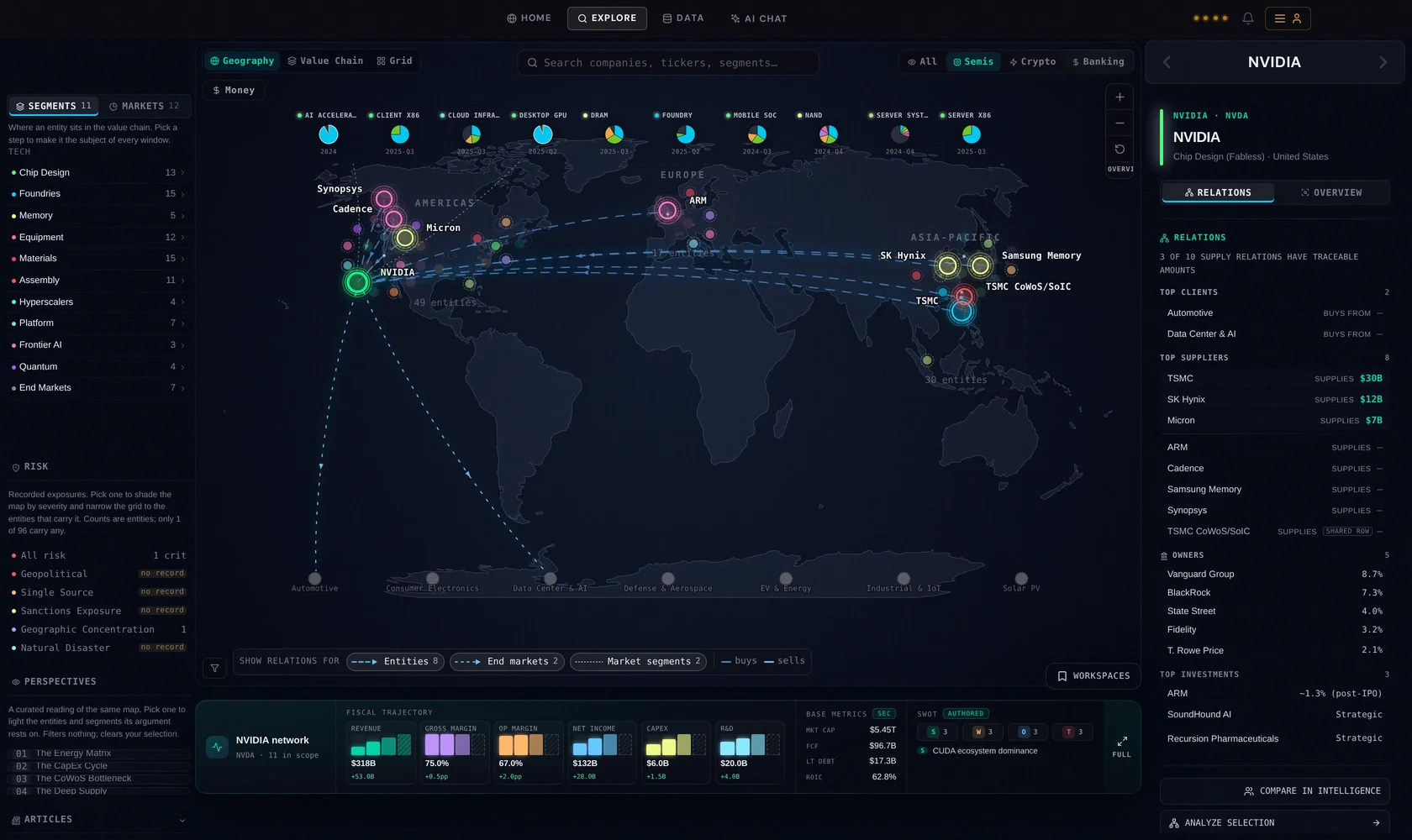
darkterminal.xyz →Vision is the furthest along of the three, so it is the one we show. This is its Explore map: the semiconductor industry as entities and the relations between them, assembled from primary filings rather than from commentary.
They are not a portfolio. They are three cuts through the same problem: a machine that does real work has to be remembered, governed, and watched — and each of those is a product once you take it seriously.
A system that forgets between sessions restarts from zero every morning. Persistence is not a feature bolted on; it is what turns activity into progress.
Capability without bounds is a liability. Every autonomous action here runs inside explicit limits, and loosening one is a recorded act rather than a quiet drift.
Most of the real failures are quiet — a worker that stopped, a number that went stale. Making the quiet parts visible is the difference between a demo and a tool.